Driving D2C eCommerce Growth with ROAS-Centric Performance Marketing
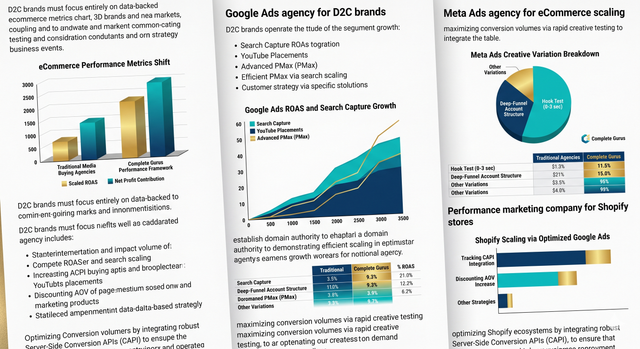
For contemporary D2C brands, success goes beyond ad spend and passive sales expectations. Strong results come from a disciplined performance system where every campaign, product feed, creative asset, audience signal and landing experience is measured against profitability. Companies exploring the Best Google Ads agency for D2C brands, the Top-rated Meta Ads agency for eCommerce scaling or a Performance marketing company for Shopify stores typically aim for one goal: scalable profitability. In a competitive market, revenue alone is not enough. A business can boost sales yet lose margin due to higher acquisition costs, poor tracking or inefficient campaign setup. For this reason, effective eCommerce scaling relies on a data-focused model measuring ROAS, CAC, AOV, repeat behaviour and net profitability.
The Importance of ROAS in D2C Scaling
ROAS remains a critical metric in D2C advertising as it reflects how effectively advertising investment converts into revenue. However, high ROAS should not be viewed in isolation. A campaign may show strong returns but fail to scale, while another may appear lower on ROAS but acquire better long-term customers. The true objective is sustainable profitability, ensuring each pound spent delivers measurable business value. For D2C brands, this means looking at product margins, fulfilment costs, discounting, returns, repeat purchases and customer lifetime value. The eCommerce brands best digital marketing agency for ROAS focuses beyond low-cost clicks and shallow conversions. Rather, it evaluates the entire funnel and develops campaigns that ensure consistent revenue across platforms.
Using Google Ads for Purchase-Ready Audiences
Google Ads remains powerful because it captures shoppers who are already searching with intent. Users searching for a product or solution are typically nearer to buying compared to those browsing social platforms. As a result, brands turn to the Best Google performance max optimization agency eCommerce for better visibility and performance. While effective, Performance Max requires organised feeds, signals, creatives and goals. Without oversight, automation can allocate budget to low-margin or low-value products. A stronger approach groups products by profitability, stock position, conversion history and buying intent, allowing the campaign to focus on revenue that actually benefits the business.
Managing Product Feeds for Performance Max
A successful Performance Max setup relies on a structured and optimised feed. Elements like titles, descriptions, images, prices and categories directly influence visibility and performance. For eCommerce platforms like Shopify, feed management should be ongoing. Products can be segmented by performance, margin, seasonality or demand trends. This allows more precise budget control. A Data-driven eCommerce performance marketing agency will also review search term insights, asset performance, conversion values and audience patterns to refine campaigns over time. The aim is not just to let automation run, but to guide it with accurate data and commercial logic.
Scaling D2C with Meta Advertising
Meta Ads serves a unique yet vital role in scaling D2C brands. While Google often captures existing demand, Meta helps create demand through strong visuals, persuasive messaging and repeated exposure. Businesses seeking the Top Meta Ads media buying agency for scaling D2C require expertise in both media buying and creative testing. In many categories, the winning ad is not the one with the most polished design, but the one with the strongest hook, clearest problem-solution angle and most believable proof. Experimenting with creatives helps uncover what motivates users to act.
Creative Experimentation for Scaling
Creative fatigue is one of the biggest challenges in paid social advertising. An ad that performs well today may lose impact after repeated exposure. This is why creative testing must be continuous. A structured system evaluates hooks, formats, offers and messaging consistently. Different creatives support awareness, consideration and conversion stages. A Best digital marketing agency for high-ROAS ad spend will connect creative testing with real conversion data rather than judging ads only by engagement. The important question is not simply whether people watched or clicked, but whether the creative attracted customers who purchased profitably and matched the brand’s ideal buyer profile.
Shopify Growth Requires Specialist Strategy
While Shopify brands grow rapidly, sustainable scaling needs proper integration. A Performance marketing company for Shopify stores connects store analytics with campaign outcomes. Often, poor results stem from weak conversion experiences rather than ads. Poor UX and unclear value propositions increase CAC. Enhancing both traffic and conversion improves ROAS efficiently.
Improving Tracking and Attribution Accuracy
Precise tracking underpins performance marketing. Tracking challenges arise from privacy and cross-device usage. D2C brands need stronger measurement systems that include server-side tracking, clean eCommerce brands best digital marketing agency for ROAS event setup, proper purchase values and first-party customer data. When platforms receive better data, they can optimise more effectively. A Performance marketing agency for D2C brands analyses multiple data sources before decisions. Combining data sources offers clearer insights.
Building a Scalable ROAS Framework
Scaling must be controlled. Rapid spend increases can reduce efficiency. If it stays too conservative, competitors may capture market share. A robust system sets targets for growth and profitability. Different campaign types support various funnel stages. A Top eCommerce growth agency for Shopify scaling integrates ads, offers and data analysis.
Finding the Right Agency for Growth
The right agency should be judged by strategic clarity, reporting quality, testing discipline and commercial thinking. The right partner is not always the fastest-growing option. It is the team that understands margins, customer behaviour, creative performance, attribution and long-term brand value. Transparency matters when budgets are high, as small optimisations drive results.
Conclusion
D2C eCommerce growth is no longer about buying traffic at scale and hoping for the best. Growth depends on structured optimisation across ads, data and creatives. A Data-driven eCommerce performance marketing agency replaces guesswork with measurable insights. Regardless of the goal, success comes from structured and tested strategies. For brands ready to scale with confidence, performance marketing must become a complete growth system rather than a simple advertising activity.